Reviews: The Bird King, G. Willow Wilson & Bird Summons, Leila Aboulela

By complete coincidence, I managed to read two books inspired by the same piece of literature one after another. That piece of literature (an epic poem, actually), is The Conference of the Birds, by Attar of Nishapur. I really don’t know a lot about Arabic literature (although I’m trying to learn more), so I was really intrigued by the story, and it was fascinating to see how these two very different novels took it as their starting point.

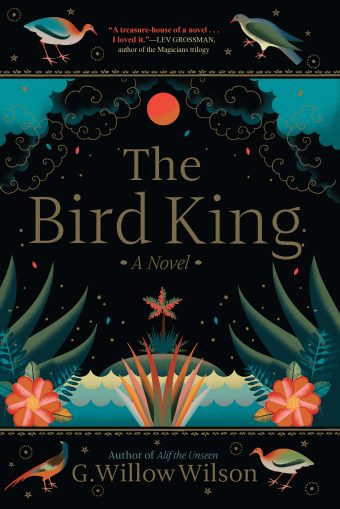
First, G. Willow Wilson’s latest offering – I really enjoyed her previous novel, Alif the Unseen, and of course her Ms. Marvel run has been fantastic. The Bird King is set during the fall of Granada, when the Spanish Inquisition is arriving in the city and the Muslim inhabitants are getting ready to surrender. Fatimah is one of the Sultan’s prize concubines, a headstrong and stubborn woman who is also very beautiful and pretty sheltered. Her best friend is Hassan, a mapmaker, and it is his magical ability that gets the story going. Hassan has a magical (or miraculous) ability to draw maps to places that don’t exist, or have been lost. Faced with the arrival of the Inquisition, Hassan and Fatimah decide to run away to the island of the Bird King, using a map Hassan draws. On the way they meet a curious cast of characters, from djinn and spirits to a Breton monk, and the villain of the piece, a Spanish lay sister who represents the Inquistion.

The story itself twists and turns so you never know what’s going to happen next. I imagine there’s an extra dimension if you’re familiar with The Conference of the Birds, because Hassan and Fatimah aren’t – the copy they have is incomplete and missing the ending. Neither was I, so I shared their curiosity and surprise at the ending of the novel.

Both of them are brilliant characters, and Wilson’s djinn are always interesting and ambiguous creatures, which I love. The Bird King is a wonderful historical fantasy, with themes of love and friendship, loyalty and forgiveness, and a fantastic female villain who turns out to be not quite what you might expect. I really enjoyed reading it!

Bird Summons is a very different book. Based on Celtic lore as well as Muslim literature, it follows three women – Salma, Moni, and Iman, who live in Glasgow. They’re different ages and have different troubles, but together they go on a pilgrimage to see the grave of Lady Evelyn, the first Scottish Muslim. The journey seems to bring out all the trials and tribulations of their lives, their secret doubts, fears, and desires. As it progresses, things slip from the real world to a strange, dreamlike world. The physical pilgrimage becomes a truly spiritual one, where they are each faced with their greatest fears and their greatest wishes, some of which turn out to overlap and none of which are quite what is expected.

As a book, Bird Summons was also not quite what I expected. I enjoyed the perspectives of the three women, their lives and histories and their relationships to one another, but I found the shift into surrealism a little jarring and struggled to follow it for a while. I was glad I’d read The Bird King first, because I recognised the story it was based on and enjoyed the conclusion from that perspective. But if I hadn’t been familiar with the original tale I would have been more than a bit lost! Still, it was a very interesting read.

Review: To Obama – Jeanne Marie Laskas

You know that saying about the right book finding you at the right time? This was the right book for me today. I’ve had it waiting in my review list for ages (like, a year, which is embarrassing), but today I sat down and read the whole thing cover to cover. I couldn’t put it down.

This is an intimate, empathetic, humble look at the Obama administration through the eyes of the people it served. As a Brit, I’m sort of detached from American politics despite the impact they have on my life (I could do with being a bit more detached these days, to be honest). This is the sort of glimpse into America that I really treasure. It’s a country that I admire in some ways but despair of in many more. There are mindsets that seem common in the US which baffle the majority of Brits, but because of our shared history we expect to always understand one another.

I think for me, this book was a paean to true democracy. When the US was first founded, there was a lot of debate between the Founding Fathers about how their democracy would work. True democracy was like the Brexit referendum – people voted individually and each individual vote was counted and the person (or issue, or opinion) that had the highest number of votes was taken forward. The Founding Fathers thought this would be too chaotic and impossible to enforce, and came up with a representative system instead. But even then much of the debate was carried out in the papers and pamphlets, and on the streets, by ordinary American citizens. Obama’s decision to read 10 letters every day of his presidency is the modern version of that ongoing dialogue between people and state.

There are letters here that made me cry, letters that made me angry, letters that made me feel proud. Families dealing with loss – from drugs, from suicide, from 9/11. Gay couples writing to say thanks for the marriage. Kids who wanted homework help. It’s a book that gives a very good impression of Obama, but the overwhelming impression I came away with wasn’t an image of him, but of America, in all its messy glory. There are very few books which capture the modern country as well as this one does, and even fewer that do it with such grace and dignity. Three years on, it was a much needed dose of hope and positivity.

Review: Pulp – Robin Talley

I picked this book up because I liked the cover and the premise sounded pretty interesting – two stories set sixty years apart, about lesbian teens growing up in DC. I try to read as much queer lit as possible, but it’s not always easy to find, particularly the f/f side of things.

The two characters are Abby, our modern teen, who is wrestling with a breakup, her parents’ disintegrating marriage, and the pressures of college applications. She finds solace in a creative writing project researching lesbian pulp novels in the 50s. One particular book, Women of the Twilight Realm, catches her attention, and she’s consumed by her obsession with finding out more about the book’s author, Marian Love.

In the fifties, Janet Jones is only just beginning to figure out that a) she likes girls, and b) so do plenty of other women. Her best friend Marie has just got a job as a typist in the state department, though, and there are rumours of the abrupt interrogations and dismissals of anyone even vaguely suspected of being gay. When Janet discovers the pulp lesbian books, she adores them as proof that she’s not alone.

Both Abby and Janet were really great characters. I liked how some of their struggles as young lesbian women were the same, but of course they were also entirely different. Abby is out and proud at school and to her friends and family – her friend group is made of a diverse range of gender identities and sexualities – and she regularly goes to protests and doesn’t hesitate to suggest writing semi-erotic lesbian pulp fiction for a school project. Janet, on the other hand, is constantly terrified, elated to find the woman she loves returns her feelings, yet petrified of what might happen to both of them if they’re discovered. I found the fifties sections much harder to read than the modern stuff – I think out of all the historical periods I read about, the fifties is probably the one I find scariest. It’s a decade we laud for its aesthetic, but when you actually look into things, it’s full of looming threats – the Cold War, Jim Crow, and the Lavender Scare all come into play to some degree or another in this book. But it seems well-researched as well as being very well-written.

Abby’s problems were much easier to confront, because they’re the sort of things that are very common for modern teenagers. She broke up with her girlfriend Linh before Linh visited her family in Vietnam last summer and thought they’d get back together when Linh returned. But they haven’t, and Abby can’t figure out how she feels or what’s going on. Her home life is also a mess, with her little brother acting out and her parents constantly avoiding each other and arguing when they’re together. She’s starting to fall behind in her classes and only reading Women of the Twilight Realm helps her to escape from it all. I really liked Abby – she felt like a very realistic teenager. The only thing I struggled with was her school, which seems incredibly liberal. Obviously, I’m from the UK (where we still don’t really have many schools like this) and my perception of US schools isn’t great – both in the media and in fiction they don’t come across very well, whereas Abby’s school seemed like paradise! The teachers accompany them to protests and the school celebrates Indigenous People’s Day instead of Columbus Day. I guess my issue here is that I’m sure schools like this exist, but it’s the first time I’ve come across one in fiction!

Anyway, I really loved the book – it was a bit longer than I might’ve liked but it’s essentially telling two separate stories, so I can understand the need for an extra hundred pages. It was just a lovely, refreshing read for me, and I’m so glad there are authors like Robin Talley out there.

Review: The True Queen – Zen Cho

I absolutely loved Zen Cho’s Sorcerer to the Crown when I read it a couple of years ago, so I was utterly delighted to hear there was a sequel on the way – and even more thrilled when I was approved for a proof copy from the publishers!

It’s been a little while since I read Sorcerer to the Crown, so I was worried I’d struggle to get back into it, but this is a book that starts off far away from the Sorceress Royal and her husband, so by the time I encountered anyone terribly familiar I was used to the world once more.

The characters at the heart of this book are almost all young women – I didn’t even realise until afterwards, but it’s incredibly entertaining and delightful to read a book and realise that the only men in it are fairly peripheral characters, or dragons. I did really love Zacharias Wythe in Sorcerer to the Crown so it was good to see him back, but he definitely played second fiddle to the inimitable Prunella, Sorceress Royal and professional scandal-maker. Of course, we all should have known that things weren’t going to be resolved by Prunella’s rise to the Sorceress Royal position, and this book deals somewhat with the aftermath. It also features a return of the wonderful Mak Genggang, Rollo Threlfall and Poggs, and plenty of other characters who fans of the previous book will recognise.

I don’t want to spoil too much, but suffice to say that this book explores much more of the world than Sorcerer to the Crown did, starting off on the other side of the world (in the Malay Archipelago) and heavily concerned with the lands of Fairy. There’s a lovely Regency-esque romance (you know, where it’s all very understated until the last minute), some excellent mysteries to unravel, and a lot of fun. Between Prunella, Mak Genggang, and some fantastic new characters, how could it not be?

I received a proof copy of this book from the publisher through Netgalley in exchange for an honest review. The True Queen is published on 21st March 2019.

Review: Once Upon A River – Diane Setterfield

I haven’t read anything by Diane Setterfield before, but the gorgeous cover sold me on this one! A lovely historical novel, this has at its heart a peculiar mystery – a lost child, thought drowned, who comes back to life.

The Swan at Radcot is a pub famed for storytellers, but the story to beat them all begins one winter night when a man staggers through the doorway with a seemingly dead child in his arms, and promptly collapses. The local nurse is sent for and dismisses the girl as dead at a glance, focusing instead on the man – and then the girl wakes. She won’t speak, and no-one recognises her. Word soon gets around, and three different parties come to claim her.

There are themes of family, of course, and hints of Gothic tales that are never quite resolved, leaving me with a pleasant chill down my spine at the end. But there are also several genuinely sweet love stories, a cast of curious and diverse characters, and a consideration of Victorian attitudes to science, religion, and the law. Mostly, though, it’s a mystery story, and one which twists and turns like the river at its heart. I had absolutely no idea how things were going to end, but found myself completely satisfied with the conclusion. In the end, though, it’s the journey that makes things enjoyable – a wonderfully detailed and complex journey through Victorian Oxfordshire and the people who lived there.


I received a copy of this book from the publisher through Netgalley.

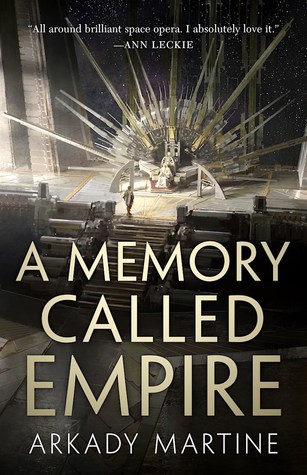
Review: A Memory Called Empire – Arkady Martine

This is a book that I knew from first glance would be very much My Thing. A space opera/hard scifi book focusing on political manoeuvring but also a murder mystery, with a female protagonist, which examines the structures and effects of empires and deconstructs imperial/colonial attitudes. There’s also a lot of linguistics in the background, and poetry! The only thing Martine could possibly have added here would be some sort of highly symbolic embroidery, and then the complex venn diagram of Things I Like would have this book at the very centre.

I’ve read some incredibly good books about empire in the last year or two. The most recent was The Traitor Baru Cormorant (published in the UK as The Traitor) by Seth Dickinson, which I read almost entirely in one sitting as I waited for a hospital appointment. I went in to that appointment with my head absolutely buzzing, and haven’t stopped thinking about the book in the five or six months since. I also adored Ann Leckie’s Ancillary Justice trilogy, which has a lot in common with A Memory Called Empire. Leckie focuses mostly on the military side of things, whereas Martine is interested in politics and diplomacy and colonisation through culture, but there are many similarities. They’re different enough, however, that I was able to enjoy A Memory Called Empire in its own right without constantly comparing back and forth.

Empires are practically ubiquitous in scifi and fantasy, and there’s a lot of fascinating reasons why. I could probably spend an entire phD digging into it, but I’ll settle for doing an actual review of this book.

Mahit Dzmare, our main character, is a citizen of Lsel Station, a small mining and pilot community based on a space station. It lives on the fringes of the massive Teixcalaan Empire, with which the Stationers have an uneasy peace. The threat of the empire suddenly deciding to conquer their region of space is ever-present, which makes for a difficult relationship. Because of the station’s small size, it also doesn’t have much of a cultural scene, and that void is filled with Teixcalaan literature and poetry. Mahit has grown up wanting desperately to visit the Teixcalaan city, and gets her opportunity when Lsel Station receives an unexpected request for a new ambassador, with no explanation of what might have happened to the old one. She’s then dumped into a culture which she adores and has spent her life studying, but finds she’s dangerously out of her depth. She must decide who to trust, what to say, and how to handle the minefield her predecessor left behind, all whilst speaking a language that absolutely swims in allegory and reference.

Martine captures wonderfully the confusion of living on the fringes of a big empire – we’re torn, as Mahit is, between loving the complexity of Teixcalaan culture and its people and the uncomfortable knowledge that it is, in fact, an Empire, and by its nature something that will cheerfully conquer other states and peoples. The friends Mahit makes in the City are her friends, but they could at any moment become her enemies. She has to keep her people’s secrets whilst also protecting them from the Empire’s clutches, and her support from home is damaged by conflicting political ideologies and attitudes towards the Empire.

The pace of the action starts rising pretty much from the first couple of chapters and doesn’t let up – there are brief pauses but always a gathering tension, and the underlying concern that Mahit doesn’t know what’s going on. You are never entirely sure who to trust, who knows what, or who the ‘bad’ and ‘good’ guys are (I’m still not sure!). There are mysteries within mysteries and I never had any idea what would happen next.

With a build-up like this, and knowing that this is supposed to be the first in a series, I was concerned that the climax would let me down a little, but I needn’t have worried. Martine tied everything together in a way that both satisfied me and left me hungry for more. Unfortunately, given that this book isn’t published til April, I have a terribly long time to wait for a sequel. I suppose I shall just have to write overly long reviews and recommend it to everyone instead.

I received a copy of this book from the publisher through Netgalley in exchange for an honest review. A Memory Called Empire is published 4th April 2019.

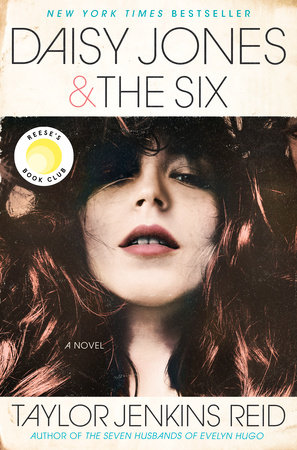
Review: Daisy Jones & the Six – Taylor Jenkins Reid

It’s absolutely criminal that I can’t listen to the songs described in this book. The music is so vividly and beautifully described that I desperately wanted to stick the album Aurora on shuffle, and play it on repeat. Sadly, this is fiction. But it’s such GOOD fiction! 

The book is formatted like an extended interview/documentary script, taking place (presumably) in the present day as the band members look back on the heady days of their success in the 70s. I’d be sceptical about this sort of structure if it was suggested to me, but it works incredibly well and made the book a really easy read. The historical setting is wonderfully evoked – it somehow made me nostalgic for an era 20 years before I was born. 

I also felt that the interview structure allowed Reid to develop strong and complex characters. We hear about actions from the point of view of the person who did them, and then see/hear how the other characters perceived and interpreted the action. This creates a great sense of the relationships between individual characters and the band’s relationship as a whole. It also gives us some amusing moments where people remember the same events differently and disagree over what happened – this is funny, but also a more serious point about the fallibility of memory, particularly in the drugged world of 70s rock and roll. Perhaps the only downside of the structure is that I left the book on the table when I was mid-way through, and came back to find my parents arguing over whether ‘Daisy Jones & the Six’ was a real band from the 70s which they had both somehow forgotten!

This is the first book by Taylor Jenkins Reid that I’ve read, although The Seven Husbands of Evelyn Hugo is on my TBR pile. It’s also shot up to the top of my 2019 read list so far (I realise we’re only a month in, but I read pretty fast and this was my 15th book of the year). I have a burning desire to recommend it to everyone I know, and there are definitely a couple of people who might be receiving a copy as a birthday present when it’s finally released. I’m so glad I received a proof of this book!

Daisy Jones & the Six will be released on March 7th, 2019.

Note: I received a proof copy of this book from the publisher in exchange for an honest review.